
Learning to Wait: What Kiln-Cast Glass Teaches Us About Time


In a world trained for speed, kiln-cast glass insists on something else entirely. It asks you to slow down. To plan carefully, act deliberately — and then wait. Not the impatient kind of waiting, filled with checking and second-guessing, but a deeper, quieter form that requires trust in process and time.
Glass does not reward haste. If anything, it punishes it.
Time begins before the kiln
The relationship with time starts long before heat is applied. Choosing powders, billets or chunks of glass is a considered act: colour density, grain size, thickness and placement all influence how the glass will behave later. Decisions made in minutes will unfold over days. This asymmetry is part of the discipline. You learn quickly that rushing the setup only multiplies uncertainty down the line.
Unlike clay, glass offers no tactile reassurance at this stage. You must imagine the outcome rather than feel it. Intention replaces immediacy.
The slow climb
Once the kiln is closed, time stretches. Kiln-cast glass moves through temperature ranges that cannot be hurried without consequence. Too fast, and stress builds invisibly within the glass. Too slow in the wrong place, and colour or clarity may suffer. The firing schedule becomes a kind of choreography — rises, holds, transitions — each one purposeful.
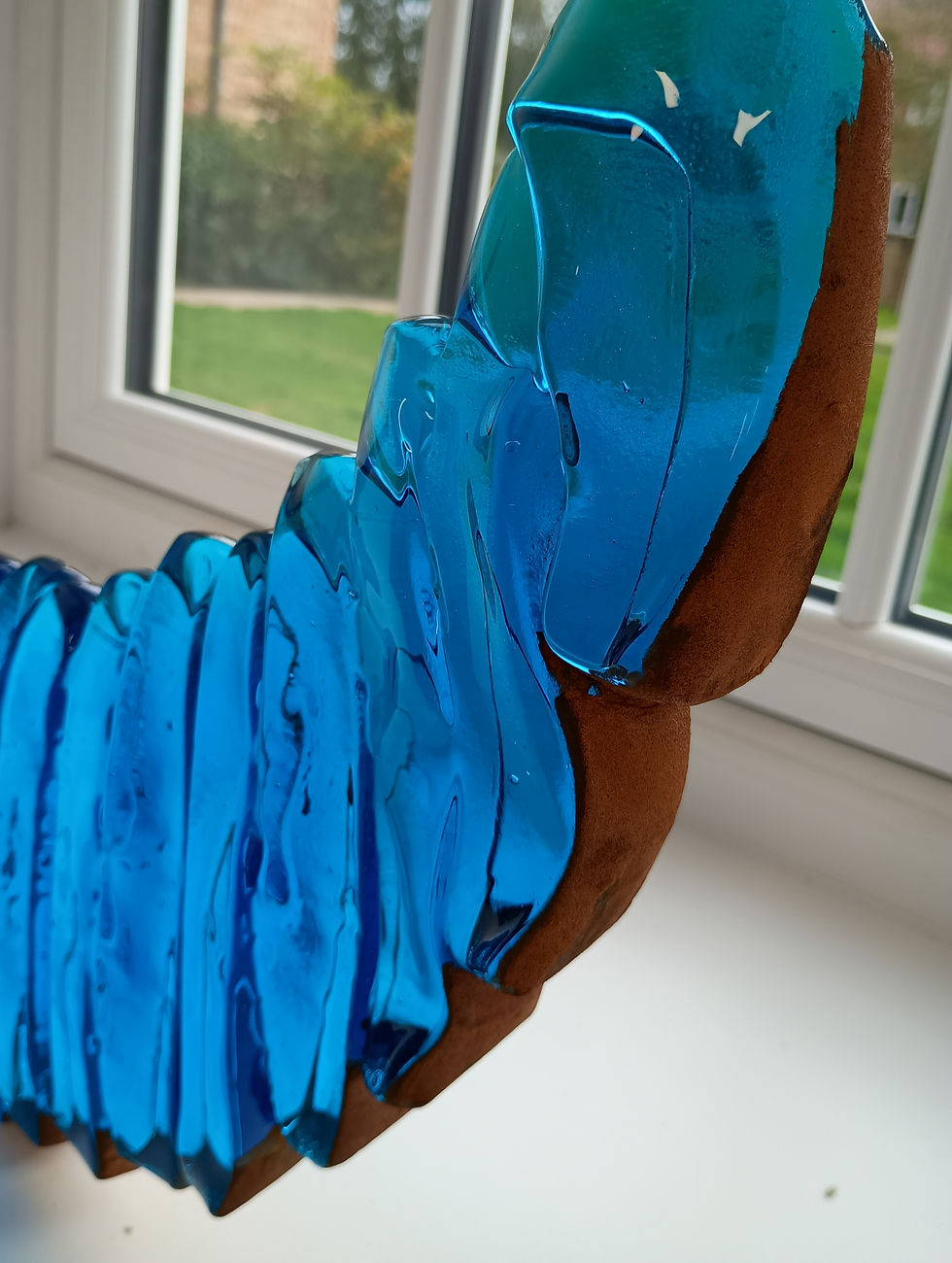
Inside the kiln, glass softens, slumps, flows and settles under gravity. These transformations happen out of sight. There is no peeking. No intervention. Waiting here is active, not passive: it’s the commitment to let the process unfold as designed.
Annealing: the unseen work
Perhaps the greatest lesson in patience comes during annealing. At this stage, nothing visibly changes, yet everything important is happening. Internal tensions relax. Molecules realign. The glass learns to exist as a stable object in the world.
Annealing can take longer than the melt itself, especially for thicker cast pieces. It’s tempting to cut this phase short — and glass remembers every shortcut. Cracks may not appear immediately. Sometimes they wait days, weeks, even months. Time, again, has the final word.
Cooling without urgency
Cooling is not an ending; it’s a continuation of care. Kiln-cast glass must be allowed to cool gradually, crossing critical temperature points with gentleness. This extended descent reinforces the idea that finishing is not the same as stopping. Completion arrives only when the glass is ready, not when we are.
The quiet reveal
Opening the kiln after a long cast firing is a subdued moment. There’s no drama, no spectacle — just the calm presence of something that has taken its time to become. Edges are softened, surfaces unified, colours settled into themselves. The piece feels resolved, not because it is perfect, but because it has been allowed to arrive fully.
What glass teaches
Working with kiln-cast glass reshapes how you think about making. It reframes productivity away from speed and towards attentiveness. It reminds you that some outcomes cannot be forced, only prepared for. That waiting is not wasted time, but an essential part of transformation.
In learning to wait, glass offers a quiet counterpoint to urgency. It asks for trust — in materials, in process, and in time itself.
And when the kiln finally opens, what emerges carries that patience within it: a solid, luminous reminder that some things are only possible when you slow down enough to let them happen.
Each kiln-cast glass piece in our collection is shaped as much by time as by heat — explore the current works to see where waiting has led.


Comments