
Raku Pottery History: Fire, Imperfection, and a Quiet Sense of Time

This post explores the raku pottery history behind the process, tracing its journey from sixteenth-century Japan to contemporary British studio ceramics.
Raku pottery occupies a distinctive place in the ceramic world. It is at once ancient and immediate, steeped in ritual yet dramatic in process. Few ceramic traditions have travelled so far from their point of origin, or evolved so visibly, while still retaining a recognisable spirit. To understand raku is to understand how clay, fire and philosophy can intersect across centuries and cultures.
The Origins of Raku Pottery History in Japan

Raku ware emerged in Kyoto during the late sixteenth century, at a moment when the Japanese tea ceremony was being reshaped by the aesthetic philosophy of wabi-cha. This
approach to tea, closely associated with Sen no Rikyū, rejected excess and symmetry in
favour of quietness, irregularity and emotional depth.
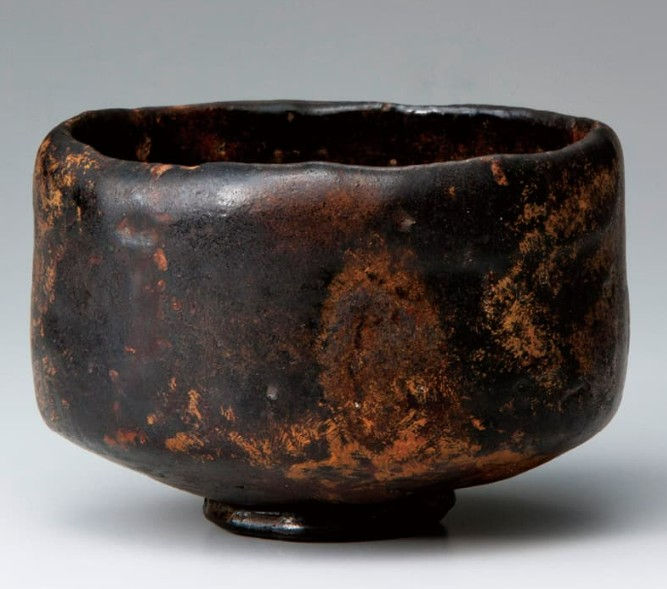
Within this context, a Kyoto craftsman known as Chōjirō began making hand-formed tea bowls unlike anything produced on the wheel. These bowls were low-fired, thickly glazed, subtly irregular and intended to be held and contemplated rather than admired from a distance. Their beauty lay not in perfection, but in restraint and tactility.
The name “Raku” became associated with this work through Chōjirō’s family, forming a lineage that has continued for generations. In Japan, raku is not simply a technique; it is a family tradition bound to tea culture, use, and philosophical intent. The bowls were never meant to be decorative objects alone. They were functional, intimate and contemplative, shaped as much by human touch as by fire.
What traditional raku is – and is not
Traditional Japanese raku is often misunderstood. While pieces are removed from the kiln while still hot, they are typically allowed to cool naturally in the open air. The dramatic post-firing reduction processes and heavy smoke effects now commonly associated with raku are not part of the original Japanese method.
Instead, the emphasis lies in form, glaze response and subtle variation. Surfaces are often quiet and matte, with crackle or pooling that reveals itself slowly over time. The resulting work rewards prolonged looking rather than instant impact.
Raku beyond Japan: process, drama and reinvention
As raku travelled beyond Japan in the twentieth century, it began to change. Western studio potters were drawn to the immediacy of the firing process and began to explore its more expressive possibilities. Fire became more visible, smoke more intentional, and unpredictability part of the appeal.

A pivotal figure in this transformation was Paul Soldner, who, in the late 1950s and early
1960s, helped define what is now widely known as American raku. By placing red-hot pots into combustible materials after firing, Soldner introduced intense reduction effects that dramatically altered glaze surfaces and clay bodies. This approach marked a clear departure from traditional Japanese practice, while still acknowledging its influence.
In this Western context, raku evolved into a communal and performative process, often carried out in shared firings where chance, timing and collective experience played central roles.
Raku in the UK: seriousness beyond spectacle
In the UK, raku found fertile ground within the studio pottery movement. Initially embraced as a teaching and workshop technique, it soon developed into a serious contemporary discipline.

One of the most influential figures in British raku is David Roberts, whose work from the 1980s onwards demonstrated that raku could be monumental, controlled and conceptually rigorous. Roberts is closely associated with the development of naked raku, a process in which smoke replaces glaze as the primary surface language, allowing fire and carbon to “draw” directly onto the clay.
Through this evolution, raku in the UK moved beyond spectacle and into a mature ceramic language, capable of producing work that is both visually striking and quietly resolved.
Raku at Village Ceramics & Crafts: a contemporary British approach
At Village Ceramics & Crafts, our raku work sits within this contemporary British tradition – respectful of raku’s origins, but rooted firmly in modern studio practice and the unpredictability of open flame.
Many VC raku vessels explore the balance between control and chance that defines the process. Crackle-glazed pieces, for example, are pulled from the kiln at peak temperature and allowed to cool before gentle reduction. As the glaze contracts, fine web-like crackles form across the surface, darkening as smoke settles into the fissures. Each line records a moment of thermal stress and release, ensuring that no two vessels can ever be the same.
British raku has also embraced scale and presence, moving beyond small functional forms into sculptural vessels that command space. Several VC raku pieces follow this lineage, using hand-built techniques such as coiling and slab construction to create grounded, architectural forms. The physical weight of the clay is softened by the movement of flame and smoke across the surface, resulting in work that feels both robust and quietly expressive.
Whether crackled, smoked or subtly carbon-marked, these surfaces are not decorative effects applied after the fact. They are formed through heat, timing and restraint — a direct record of the firing itself.
Why raku still resonates
Raku endures because it embraces impermanence. Cracks, smoke marks and irregularities are not flaws to be corrected, but evidence of a moment in time. Each piece is unrepeatable, shaped by decisions made in seconds and reactions that cannot be fully controlled.
For contemporary interiors, raku offers something quietly powerful: objects that carry the memory of fire, the trace of the maker’s hand, and a sense of immediacy that polished perfection can never replicate.
Traditional Japanese Raku vs Western Raku (at a glance)
Traditional Japanese Raku
Origin: 16th-century Kyoto
Purpose: Tea ceremony vessels
Making: Hand-formed
Firing: Low temperature, open-air cooling
Aesthetic: Subtle, restrained, contemplative
Western / UK Raku
Origin: Mid-20th century studio pottery
Purpose: Sculptural and decorative ceramics
Making: Hand-built or thrown
Firing: Post-firing reduction in combustibles
Aesthetic: Crackle, smoke markings, carbon patterning


Comments