
When Two Crafts Collide: Binding a Year of Ceramics Monthly


Every now and again, two completely different creative worlds bump into each other in the studio and something rather lovely happens. As well as spending my days shaping clay, firing pots, and experimenting with glazes, I also dabble—enthusiastically, if not expertly—in the traditional craft of bookbinding. I’m very much an amateur, and none of my handmade books are destined for the Village Ceramics & Crafts online store, but the process itself is hugely calming. There’s something meditative about folding, sewing, pressing and covering a book by hand… it feels like a craft cousin to pottery.
Just recently, those two worlds collided in the best possible way. Over the last twelve months, we had accumulated a full year’s run of Ceramics Monthly, the ever-reliable companion of potters everywhere. Rather than letting the stack grow wilder and wobblier by the week, I decided to bind the issues into one substantial, old-fashioned hardback folio—a sort of annual edition to keep in the studio for easy reference. And so began the slightly nerdy joy of turning loose magazines into a single, beautiful volume.
The process started, as most bookbinding projects do, with organising the stack and

preparing the sections. Each issue was lined up in order, covers intact, ready to be stitched.
Using the sewing frame, I marked out the sewing stations along the spine and opened the signatures one by one. An awl in hand, I pierced the fold of each magazine, creating neat holes ready for the stitching that would eventually hold everything together.
Once the stations were pierced I set up my linen tapes at the edge of the table—good strong ones that would add stability to the final binding—and began stitching each issue to the next, looping carefully around the tapes for extra support. There’s a rhythm to this bit: pierce, stitch, tighten, move on. Before long, the loose pile of magazines was transformed into a single, satisfyingly chunky text
block.

With the sewing complete, the spine needed reinforcing. Into the finishing press it went, clamped firmly while I applied a layer of PVA, followed by a length of mull, that open-weave fabric bookbinders use for extra strength. Letting it dry in the press felt a bit like watching a kiln cool—slow, steady, and very tempting to poke before it's ready.
Next came one of my favourite parts: crafting the cover. I cut two sturdy grey-board panels and prepared the spine piece, then chose a deep navy book

cloth for the quarter binding. Once glued down, the cloth created a lovely contrast with the patterned Italian paper I’d picked for the main cover—a gorgeous geometric design in warm yellows, teals, and blues. It felt modern but still had that timeless “special edition” vibe that suits a bound periodical perfectly.
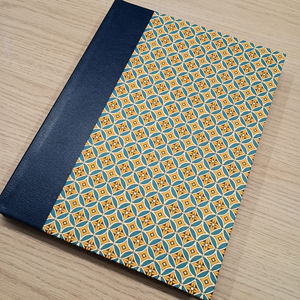
After assembling the case, it was time for the dramatic moment: casing-in the text block. The tapes were trimmed flush, endpapers attached, and the whole thing nestled into the cover before going back into the press for a final firm squeeze. A day later, I finally opened it—my very own Ceramics Monthly annual, neat, weighty, and deeply satisfying to leaf through.
This handmade volume will now live in our Lincolnshire studio, ready to be pulled down

whenever inspiration strikes. Whether we're checking glaze tests, admiring another artist’s firing technique, or simply enjoying a quiet coffee-and-ceramics moment, it’s good to have a whole year of reference material bound into one beautiful book.
Two crafts collided—and honestly, I hope they collide more often.


Comments